
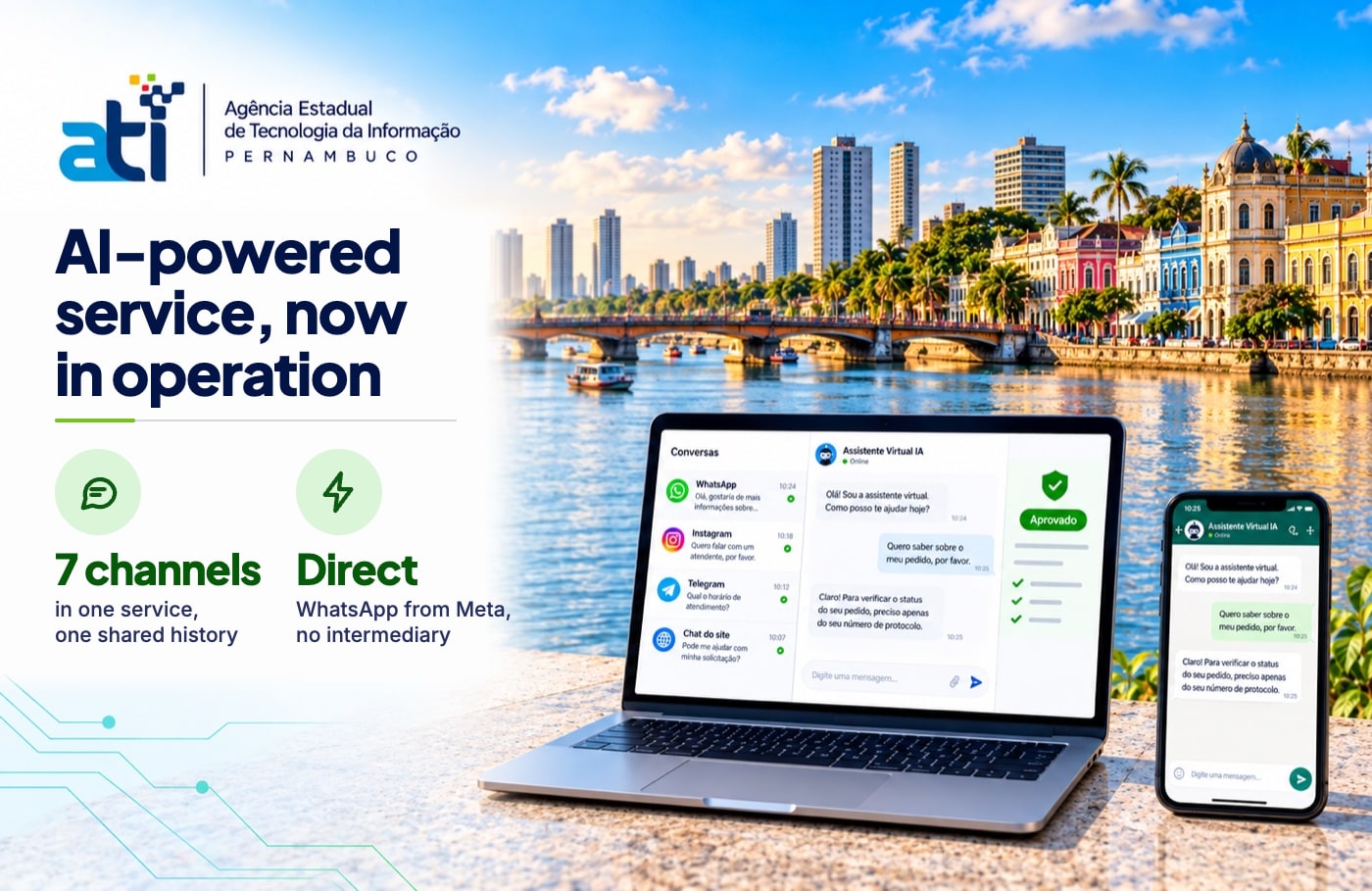
Seven channels in one service, with the entire conversation history in one place.
Project context
The AI strategy ATI leads in Pernambuco, how the agency serves citizens with AURA, and the evaluation the service passed before going live.
AI governed by the state, and one citizen service on any channel.
The Pernambuco State Information Technology Agency (ATI) leads the State Artificial Intelligence Strategy, which puts the state's agencies under the same governance and regulation rules, brings government closer to academia, builds the data and GPU infrastructure, and trains public servants. At Gartner CIO 2026, ATI's president, Fred Vasconcelos, said Pernambuco is one of six states with a published AI strategy.
For citizen service, ATI uses AURA, Central IT's AI-powered omnichannel service. WhatsApp, Telegram, Instagram, Messenger, Teams, the website widget and voice all reach a single service, with the entire conversation history in one place. The AI understands what the citizen is asking, even without an exact keyword, and answers only within the knowledge base the agency approved; when needed, it hands the conversation to an agent with everything already said. Before going live, AURA went through a formal evaluation by ATI and was approved in all 320 test scenarios.
About ATI and the operation
The strategy the agency leads, where citizens reach the service, and what sustains trust in it.
Agency
State Information Technology Agency (ATI), Government of Pernambuco
State AI Strategy
- Common rules for every agency: applications, governance and regulation
- R&D with academia: UFPE's Informatics Center, CESAR School and UPE
- Data infrastructure and three interconnected data centers, with orchestrated GPUs
- Training for public servants and the state's own AI, IA+PE
Channels in one service
WhatsApp, Telegram, Instagram, Messenger, Teams, website widget and voice
Evaluation before going live
Approved in 320 of 320 test scenarios, across 28 requirements
What AURA does
- AI-powered virtual assistant and chatbot, alongside the fixed menu tree
- Recognizes intent, context, tone, slang and new expressions
- Queue, handoff to a human, unified history and access profiles
- Voice responses, polls, ticket integration and indicators
WhatsApp channel
- Central IT, a Meta Business Partner specializing in WhatsApp
- Verified by Meta as a technology provider
- Direct connection to Meta's Cloud API, with no third-party BSP
Results in numbers
0
Channels in one service
WhatsApp, Telegram, Instagram, Messenger, Teams, website and voice, with one shared history.
1 of 6
States with an AI strategy
published in Brazil: Pernambuco is one of them, according to ATI-PE's president.
0
Interconnected data centers
at ATI, the State Treasury and Education, with GPUs orchestrated for the state's AI projects.
Direct
WhatsApp from Meta
a connection to Meta's Cloud API, with no third-party BSP in the chain.
Strategic points
Challenges
Taking AI from pilot to production is harder in the public sector. At Gartner CIO 2026, ATI-PE's president, Fred Vasconcelos, pointed to the difficulties specific to government: how it buys, how it organizes itself and how it trains its servants. Pilots with in-house, outsourced and partner AI appeared without a common rule, and when they worked, governance came afterwards.
In citizen service, people look for government through whatever channel they already use: WhatsApp, Instagram, the website, the phone. When each channel is a separate service, the conversation restarts from zero at every switch, the queue doesn't talk to the history, and the agent doesn't know what's already been said. For an agency serving an entire state, that turns into rework and waiting.
And AI-powered service in the public sector has one extra requirement: the answer has to stay within what the agency approved, and the service has to do, in operation, what the procurement called for, not just in a demo prepared by the vendor.
Solution
Pernambuco's answer was a single strategy, led by ATI: common rules for AI applications, governance and regulation, research and innovation with academia, data infrastructure and training for public servants. On that base, the agency built what other AI projects use, such as the orchestration of GPUs across the state's three interconnected data centers and its own AI, IA+PE, which public servants can use.
For citizen service, ATI uses AURA. Every channel reaches a single service, with the conversation history in one place, even when the citizen switches channels midway. The script is assembled in blocks by the business area, with no coding; IT only steps in when a step needs to talk to another system, like opening or checking on a ticket.
The AI understands the citizen's intent even without an exact keyword, tracks context across messages, reads tone and understands informal language. It answers only within the knowledge base the agency approved, with a configurable confidence threshold: below it, the conversation goes to an agent, who receives the summary and the suggested answer, with the sources visible.
On WhatsApp, the chain is short. Central IT is a Meta Business Partner, specializing in WhatsApp, and verified by Meta as a technology provider. The connection is direct to Meta's Cloud API: number quality, sending limits and throughput come straight from Meta to the console, with no third party in between charging per conversation.
Before going live, AURA went through a formal evaluation by ATI: 28 functional requirements broken down into 320 test scenarios, with the evaluator operating the tool. Approval on all 320, with the result logged in report F35–F62.
Measurable delivery
Results in operation
What citizen service gained with AURA in operation at ATI, and what sustains trust in it.
Results
AI that understands intent, context, tone, slang and new expressions, and answers within the knowledge base the agency approved.
Handoff to an agent with the full conversation, so the citizen never repeats what was already said.
Voice service and responses in the same flow as the text channels.
Integration with tickets, polls, access profiles and service indicators.
WhatsApp connected directly to Meta's Cloud API, with no third-party BSP in the chain.
Approval in 320 of 320 scenarios before going live, logged in report F35–F62.
Impact
For citizens, service stops depending on the channel: they write the way they speak, through the app they already use, and don't have to restart the conversation when handed to a person. For ATI, which stands for AI governed by the state, the service that reaches citizens is the same one that was approved item by item before going live, with a formal methodology and a documented trail: quality that doesn't depend on the vendor's word. At Gartner CIO 2026, Fred Vasconcelos thanked Central IT as "a partner at every hour".
In Pernambuco, no agency adopts AI on its own.
ATI-PE at Gartner CIO 2026
Pernambuco's AI strategy, from rules to production.
With Fred Vasconcelos, President of ATI-PE. Video in Portuguese.

Talk to a Central IT specialist
See how AURA serves citizens on every channel, with AI that answers only within the approved knowledge base and WhatsApp direct from Meta. Our team helps design the path, from diagnosis to operation.